
Author: Johnny Sharland
The selloff in global bonds has made headlines recently, with the US 30-year Treasury yield, for example, rising to its highest level in almost 20 years. Similar moves have occurred in other developed markets.
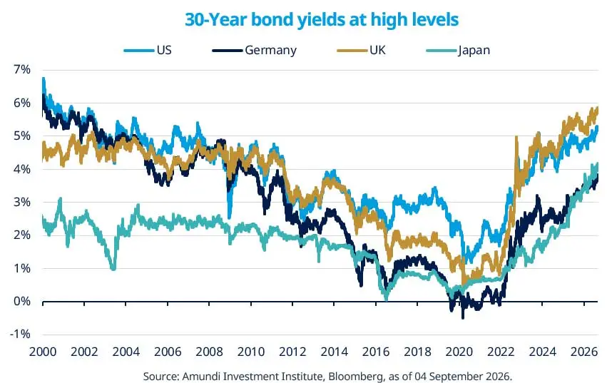
There are many potential reasons for the rise in bond yields we have seen, but we will focus on three of the main factors.
Inflation
The Iran war has sharply increased the price of oil and other commodities. This feeds through directly to higher energy prices, and indirectly to many other goods through higher input prices. With no resolution to the conflict in sight, this may not be a temporary move. Indeed, in its latest Monetary Policy Statement, the Reserve Bank of New Zealand (RBNZ) said they expect inflation to stay high for the remainder of 2026. The RBNZ have already hiked the Official Cash Rate twice.
In the US, the war has shifted expectations for the Federal Reserve’s monetary policy from interest rate cuts to hikes.
Higher short-term interest rates and higher inflation (as well as more uncertainty about future inflation) have caused bond yields to rise.
Government Debt Levels
At the same time, there is renewed concern about the fiscal situation of many developed market countries, including the US and Western Europe. In the US, Federal debt recently ticked over USD$40 trillion. The US government currently spends around $2 trillion more each year than it generates in revenue. Current policy settings suggest deficits may remain elevated. President Trump has promised a USD $5,000 ‘dividend’ to every adult US citizen if Republicans retain control of the House and Senate after November’s midterm elections. This would cost over $1trillion. He has suggested this would be funded by tariff revenue, but tariffs are expected to bring in only $125bn in revenue next year according to the Tax Foundation.
European nations also have high debt levels and slowly growing economies. New UK Prime Minister Andy Burnham previously said he would spend more, which worried UK bond markets. He has notably changed his tune since becoming Prime Minister and attempted to reassure markets that he is committed to fiscal sustainability.
In France, the deficit is around 5% of GDP, and politicians there have struggled to agree on a way forward. In 2023, an attempt to raise the retirement age from 62 to 64 (to address the deficit) was met with nationwide protests and strikes. Like the UK, Prime Ministers have had short tenures recently, with six since 2020.
At the same time as governments face political pressure to support citizens facing the high cost of living, they are also under pressure to revitalise their militaries and arms industries. President Trump has pushed NATO members to spend 5% of GDP on defence, while European governments face rising security concerns, which have contributed to pressure for higher defence spending.
When market participants worry about a country’s long-term debt sustainability, they will demand a higher risk premium (higher yield) to compensate for the risk of a default or currency devaluation.
Global Competition for Capital
We are currently in the middle of an enormous cycle of capital expenditure by companies involved in building out Artificial Intelligence (AI). This spending is going towards data centres, advanced chip manufacturing, and energy infrastructure. US bank Goldman Sachs expects total global AI investment to exceed USD $1 trillion in 2026.
Until recently, most of the players involved funded this out of their own cash flows. They are now issuing debt to raise the investment capital they require. After negligible levels of AI-related corporate bond issuance in 2020-24, it jumped to USD $93bn in 2025 and is expected to come in somewhere between $300-500bn in 2026.
This is happening as governments continue to borrow heavily to fund their deficits. The extra supply of bonds coming to the market from corporates is creating competition for capital. If the supply of bonds increases, all else being equal, their prices must fall. Falling bond prices equal higher yields.
What The Bond Market Is Telling Us
All of this sounds alarming, but the move higher in global yields has been orderly, with minimal market disruption. Bond-market volatility has not meaningfully increased. The Merrill Lynch Option Volatility Estimate (MOVE index, known as the ‘VIX’ of bonds) is a widely quoted indicator of bond-market volatility. It currently sits at around 82, below where it has been for much of the past 5 years.
Issuers are still finding buyers for bonds. In the latest 30-year Treasury bond auction (Sep 10), the US Treasury Department received $57bn worth of bids for $22bn of bonds on offer, a bid/cover ratio of over 2.5x.
While we have talked about government finances, in the US at least, the story is different in the corporate and household sectors. Both corporate and household levels of debt as a percentage of GDP have declined. Corporate profitability is at record levels, suggesting there is plenty of capacity to withstand higher borrowing costs or softer economic conditions ahead.
With government debt, one must bear in mind that government finances are not like household finances. Governments don’t retire or die, and they can continue to refinance debt indefinitely (so long as someone will lend to them). Many people assume that huge government debt levels will necessarily result in some sort of crisis or default. This is not inevitable.
What happened in the UK in 2022 during Liz Truss’ 49-day stint as Prime Minister shows how markets can ultimately force politicians into fiscal discipline. The bond market rejected a ‘mini budget’ of unfunded tax cuts, and Truss was forced to resign. New leaders reversed most of the policies that had alarmed markets. This was a short-lived crisis, and markets returned to normal functioning relatively quickly. There was no default or catastrophic financial crisis. One could, of course, argue that such an event in the US Treasury market would be more destabilising than a smaller bond market such as the UK.
Could there be trouble ahead for government bond markets, forcing political leaders into hard choices? At some point it is likely there will be, but as I repeatedly say to my children during a car journey of any length, ‘we aren’t there yet’.