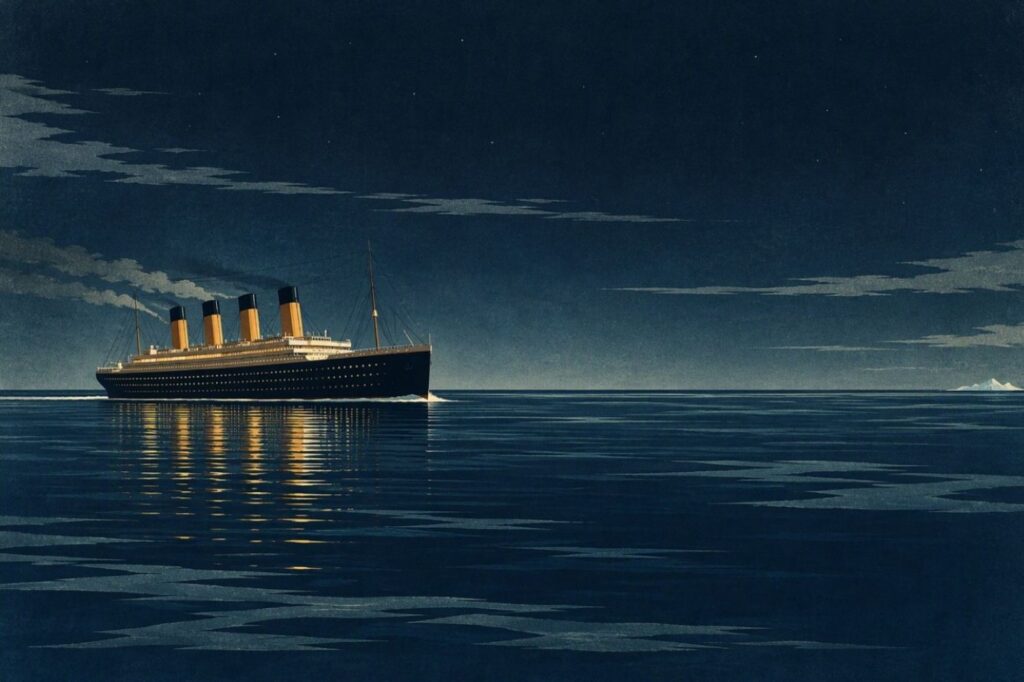
I was pretty young when Titanic came out in 1997, so that was probably my first introduction to the story. The movie was huge, and somehow Jack and Rose also created an entire generation of people who couldn’t get to the front of a boat without doing the “I’m flying, Jack!” photo. My mum also made me cover my eyes during certain scenes, although at that age that was probably fair enough! It is pretty remarkable that the Titanic sank back in 1912, yet more than a century later we are still fascinated by what happened that night.
I have noticed quite a few articles about the Titanic popping up again recently, so I did a bit more digging. We all know the iceberg played the starring role, along with the shortage of lifeboats. But what I found more interesting was everything else that contributed. There had been warnings about ice. The collision allowed water into more watertight compartments than the ship could survive. Even though there were too few lifeboats, some left without being full, and for those who ended up in the freezing water, time was very much against them.
It was not one thing. It was a number of risks coming together at the worst possible time. And that is where I started seeing the comparison with investing. Whenever markets fall heavily, we naturally focus on the iceberg. What caused it? Could we have seen it coming? What will the next one be?
But perhaps we spend too much time trying to work out what the next iceberg will be, when what matters more is what shape our finances are in when we eventually hit one.
How much investment risk should you take?
How fast are we travelling?
One thing I found interesting was that Captain Edward Smith was not inexperienced. He had decades of sea experience. Yet despite receiving warnings about ice, the Titanic maintained its speed. Knowing about a risk and actually adjusting for it are two different things.
Risk has a funny way of not feeling very risky when everything has been going well for a while. Sometimes experience gives us confidence. Sometimes, if we are not careful, it gives us a little too much. Taking investment risk is not a bad thing. The question is how much we actually need to take. The goal is not to travel as fast as possible. Sometimes we simply do not need to.
How diversification helps manage investment risk
How much depends on one thing going right?
The Titanic was designed with watertight compartments. Damage to part of the ship was not supposed to mean losing the whole ship. The problem was that too many compartments were compromised. Diversification will not stop a portfolio from falling when markets fall. What it can do is make us less dependent on one company, country, sector or investment idea. A particular company might be great. A property might be fantastic. Someone might have a very convincing view about where an industry is heading.
Maybe they are right. But I would still ask: What happens to your financial plan if you are wrong?
That, to me, is the more useful question.
Why cash reserves matter when markets fall
Then there are the lifeboats.
The lifeboats are the part I find particularly interesting. The Titanic did not have enough lifeboat places for everyone. Yet, surprisingly, the ship complied with the lifeboat regulations that applied at the time.
Meeting the minimum standard and being properly prepared are not necessarily the same thing.
A financial plan can tick plenty of boxes too. Investments, insurance, KiwiSaver, emergency savings, estate planning. But do all those pieces actually work together for the person sitting in front of us? A lifeboat does absolutely nothing to make a ship go faster. Most of the time it just sits there. Until you need it. Cash reserves, defensive investments and having other resources available can feel a bit like that. They can still contribute to returns, but they also have another job: providing some stability and flexibility when growth assets are having a difficult time.
Their value is not just about return. It is also about giving you choices.
If markets fall, having other resources available may mean you do not have to sell long-term investments at exactly the wrong time.
Not every dollar needs to work as hard as possible. Some money is there to give the rest of it time to recover.
Managing emotions during a market downturn
Having lifeboats is one thing…
Knowing what to do with them is another. Despite there already being too few lifeboat places, some left without being full. You can build what looks like the perfect portfolio on a spreadsheet. That does not necessarily mean you can live with it. It is easy to say you are a long-term investor when your portfolio is going up. It gets a bit harder when your portfolio has fallen significantly; every news story seems negative, and someone at the weekend barbecue tells you they moved everything to cash three months ago. That is when knowing why you are invested the way you are matters.
Has something actually changed in our lives, goals or financial position? Or has only the market changed? We are human. Money is connected to our family, security, choices and future. The objective is not to remove emotion, but to understand it well enough that it doesn’t make the decision for us.
How your investment time horizon shapes your portfolio
And finally, time.
For those who ended up in the freezing Atlantic, time was very much against them. For investors, time can be one of our greatest advantages.
But only if we actually have it. If someone needs $100,000 next year for a house, that money has a very different job than $100,000 they don’t expect to touch for another 20 years.
Same amount of money but a completely different job.
And this is where investing really becomes financial planning. Before asking “What should I invest in?”, perhaps the better question is:
“What does this money need to do for me?”
When will I need it? What else do I have available? What happens if life does not go exactly according to plan? Because a portfolio doesn’t exist independently of someone’s life. It has a job to do.
Preparing your financial plan for the next market downturn
So, what is the next iceberg?
I have no idea. And I am actually pretty comfortable with that answer. Another market fall will happen at some point. Maybe it will be a recession, geopolitics, something happening in financial markets, or something hardly anyone is talking about today. I do not think successful investing requires us to correctly predict every iceberg.
What matters more is taking an appropriate amount of risk, not depending too heavily on one outcome, having resources available when we need them, and giving our long-term investments time to do their job. We remember the iceberg. But the iceberg was only part of the problem.
We cannot control when the next iceberg appears. But we can make sure our financial plan is built with one in mind.