Why Sticking with Your KiwiSaver Strategy Matters During Market Volatility
Periods of market volatility create uncertainty, especially when you see your KiwiSaver balance fluctuating more than usual. Recent global events, including conflict in the Middle East, have disrupted trade flows and unsettled investor confidence worldwide. This has contributed to noticeable drops across share markets and increased volatility within KiwiSaver funds.
While these fluctuations may feel worrying in the moment, they’re entirely expected. More importantly, they do not change the fundamental principles of long-term investing. Decades of evidence show that maintaining your strategy through turbulent markets is one of the most effective ways to build long term wealth.
Market Volatility Is Normal and Necessary for Long-Term Growth
Financial markets naturally rise and fall as economic conditions evolve. After extended periods of strong performance, it’s common for markets to experience pullbacks that reset valuations and prevent excesses from building. This latest period of volatility is simply another example of that cycle. A reminder that markets never move upward in a straight, predictable line.
While downturns may be uncomfortable, they have historically been followed by periods of recovery and new growth. In fact, long-term returns exist precisely because markets go through periods of uncertainty. Investors are rewarded for staying the course when conditions feel challenging.
Switching Funds in a Downturn Often Locks in Losses
One of the most important principles in evidence-based investing is avoiding kneejerk reactions. When balances fall, some investors consider switching to conservative funds to “wait things out.” However, switching after markets have already dropped often turns temporary declines into permanent losses.
Recoveries also tend to begin quietly. Some of the strongest days in the market often occur very close to the weakest days. Miss those early rebound periods, and your long-term returns suffer. Trying to time these movements is extraordinarily difficult, even for professionals and is usually detrimental.
Staying invested maximises your chances of capturing the recovery when it arrives.
KiwiSaver Is Designed for Long Time Horizons
KiwiSaver isn’t built for short-term gains; it’s designed for life goals such as retirement or purchasing a first home. These objectives play out over many years, which means short-term market swings have far less impact than they appear to in the moment.
A drop in your balance doesn’t mean your chosen fund is wrong. What matters is whether your fund aligns with:
- Your time horizon
- Your tolerance for risk
- Your long-term goals
If these haven’t changed, your strategy likely remains appropriate.
Short-term volatility becomes far less significant when viewed through a decadeslong lens.
Volatile Markets Create Opportunities for Future Gains
Although it might not feel like it, market declines can actually benefit long-term KiwiSaver investors. When share prices fall, each contribution buys more units. This is the essence of dollar cost averaging, buying more when prices are lower.
Over time, as markets eventually recover, those extra units compound more effectively and help build stronger long-term outcomes. Continuing to contribute during downturns positions your KiwiSaver for greater long-term growth.
Evidence: Missing Market Highs Has a Huge Cost
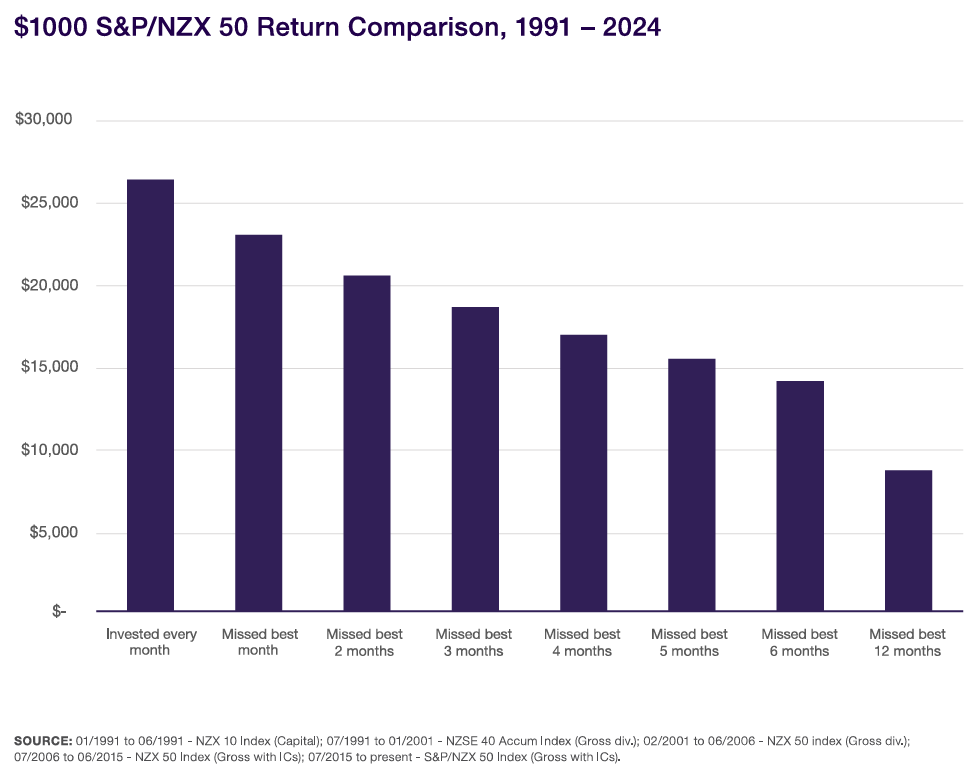
Market gains are often concentrated in only a handful of months.
According to long-term NZ market data (1991–2024):
Share market gains are not evenly spread; in many years, one or two months account for nearly all of the year’s outperformance compared with term deposits.
- $1,000 invested continuously in the NZ market over this 34-year period would have grown to over $26,000.
- But missing just the best one-month drops that return to around $23,000.
- Missing 12 of the best months cuts the long-term return to around one-third of what the continuous investor achieved.
This is why consistency matters:
You must be invested to capture the best market days, and they often occur when the outlook still feels uncertain.
Investor Behaviour Often Matters More Than Market Movements
Market volatility tends to trigger emotional responses. This is why behavioural discipline is such a critical part of long-term investing. Checking your KiwiSaver balance too often can raise anxiety levels and lead to decisions that undermine your strategy.
Remaining calm and sticking to your plan, even when headlines are negative, is one of the most reliable ways to support long-term success.
Your behaviour during downturns has more influence on your final outcome than the downturn itself.
How to Navigate Volatile Markets with Confidence
- Stick to the fund that matches your long-term goals
If your timeframe hasn’t changed, your strategy probably doesn’t need to either. - Continue contributing regularly
Lower prices mean you buy more units per contribution, a powerful long-term advantage. - Limit how often you check your balance
This helps prevent emotion driven decision making. - Focus on what you can control
Your savings habits, contribution rate, and overall plan matter far more than temporary market movements. - Reach out before making changes
A discussion grounded in your goals is far more constructive than reacting to short-term market noise.
Final Thoughts: Discipline Is Your Most Powerful Investment Tool
Market volatility is uncomfortable, but it is temporary and completely normal. KiwiSaver is built specifically to handle these periods, and evidence-based investing consistently shows that staying the course is one of the most effective ways to achieve long-term growth.
If you’d like a personalised review of your KiwiSaver, we’re here to help.